PHASE 02
Proportions
Observation, balance and composition
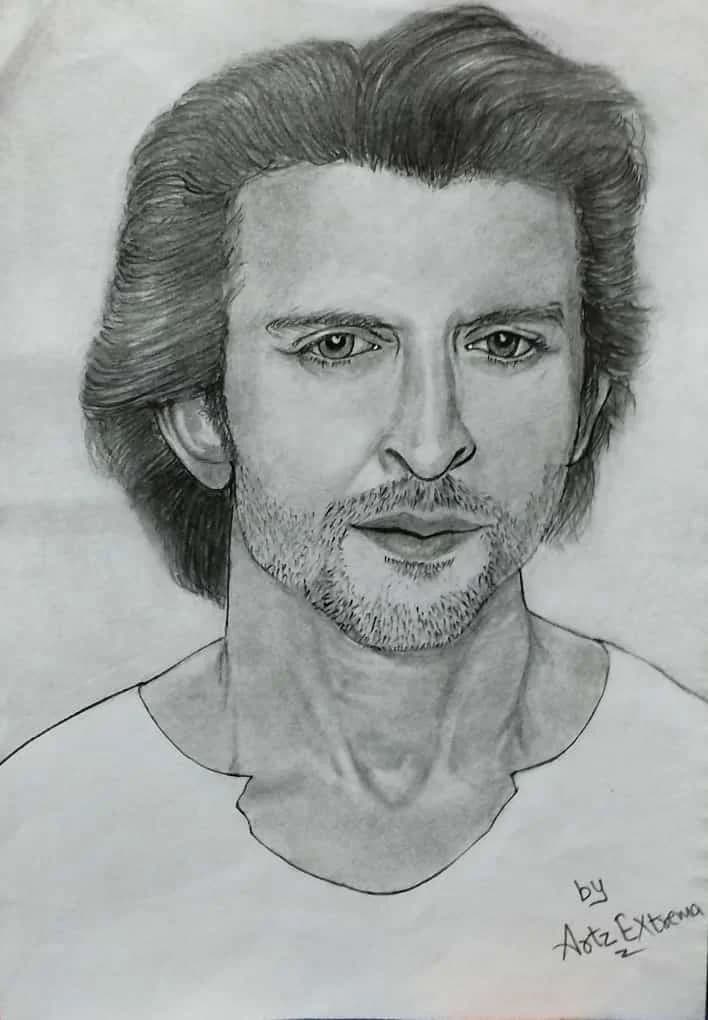
For enrolled students · what you'll actually do
18 exercises
18 exercises — tap any one to see what to do, what you learn, and what success looks like.
The first time you notice your own proportion mistake before the teacher points it out — that's the real breakthrough. The graphite smells of the kneaded eraser you've been working, the paper faintly cool where your forearm rests. Suddenly you're not just drawing; you're seeing. The eye learns faster than the hand here, and the page starts to feel like a window rather than a wall.
What this phase builds
Focus & the tools you'll meet
Focus areas
- 01
Measuring with sight-size and comparative proportion (thumb-on-pencil)
- 02
Negative space and the envelope — blocking the whole before the parts
- 03
Compositional balance — rule of thirds, weight, and breathing room
Tools you'll meet
- Graphite pencils (same HB–6B set from Phase 1)
- Printed reference photos at A4 — a stable subject to measure against
- Viewfinder / framing L's — find the crop before you draw
- Toned charcoal paper — mid-tone ground makes value obvious
- White charcoal pencil — recover highlights on toned ground
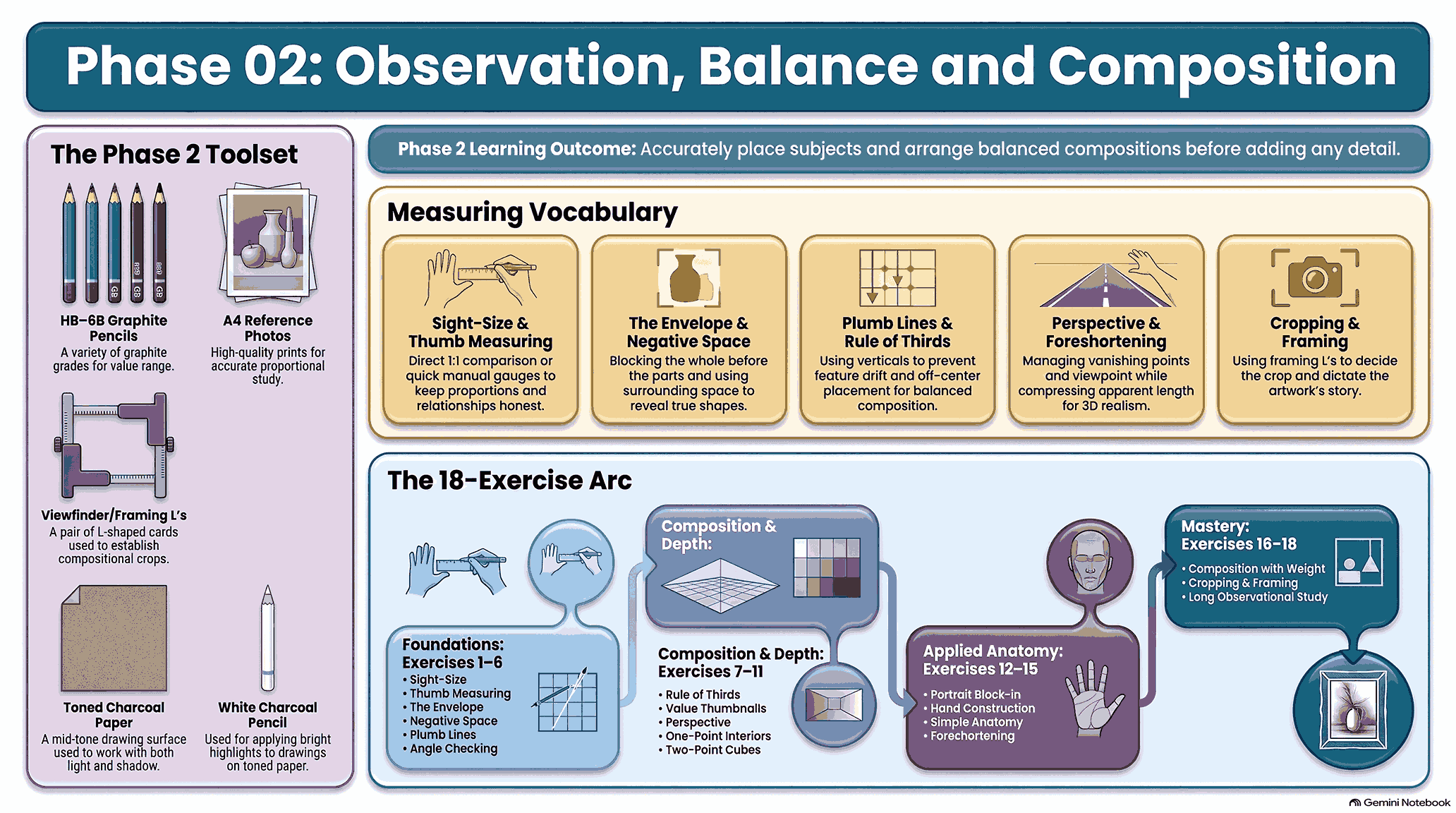
At a glance · shareable
Phase infographic
A one-page visual cheat-sheet of the tools, focus, and practice in this phase.
For class · print
Slide deck
A printable exercise & tool deck — handy in the studio or to email home.
Open PDF ↗Download PDF ↓For students
Study guide for this phase
Key concepts, a short quiz, essay questions, and a glossary to revise between classes.
Dear Student
This guide serves as a comprehensive resource for students and parents navigating the Phase 2 — Proportions module at Meenakshi Art Work academy. This six-week observation, balance, and composition module contains 18 core exercises designed to transition the student from simply drawing lines to truly seeing relationships. By the end of this phase, students will have the ability to place any subject accurately on the page and arrange it for visual balance before a single detail is added.
Key concepts
In the studio, we transition from the tight, hesitant strokes of beginners to the intentional, observant eye of the artist. This starts with understanding sight-size and comparative measurement. While sight-size allows for a direct 1:1 scale transfer, comparative measurement empowers the student to scale any subject using a "thumb-on-pencil" unit to keep relationships honest. Before detailing, we establish the envelope, a simplified multi-sided polygon that captures the height-to-width ratio of the whole subject. We then use the block-in method, breaking form into straight-line geometric structures to ensure the structural skeleton is accurate.
To achieve objective accuracy, we often look at negative space — the abstract shapes of empty space around a subject — which bypasses our mental preconceptions of what an object "should" look like. We rely on plumb lines to maintain vertical alignment and angle checking to transfer specific tilts to the page without guesswork. Compositional integrity is managed through the rule of thirds, dividing the canvas into a 3×3 grid to place focal points for dynamic balance, and value thumbnails, which are small sketches used to plan light and shadow masses. As the work moves into three dimensions, we introduce one-point and two-point perspective, eye-level shifts, and foreshortening to handle compressed lengths. Finally, we consider visual weight to ensure the page feels balanced, using cropping and framing to choose the specific "window" that best tells the story of the artwork.
Short-answer quiz
Why does measuring with your pencil beat guesswork?
Comparison keeps relationships completely honest by scaling units rather than guessing.
What does drawing the negative space reveal?
It reveals the true, objective shape of the subject by focusing on the abstract shapes of empty space around it.
What does a plumb line keep aligned?
It keeps features aligned on a true vertical axis to prevent structural drifting.
Why is "the envelope" drawn before individual parts of a subject?
It captures the absolute height-to-width ratio and gesture of the overall composition before the student ever details individual parts.
What is the primary purpose of a value thumbnail?
It allows the artist to quickly map out the light and shadow masses to ensure the composition has strong visual impact.
How does angle checking improve the description of a form?
It allows the artist to transfer a specific tilt directly to the page to describe form with sharp, accurate lines rather than guesswork.
What does the rule of thirds provide for a composition?
It creates a natural sense of dynamic balance, visual weight, and "breathing room" rather than centering everything statically.
Why does the studio use a "block-in" stage with straight lines?
This phase establishes large structural masses and proportional boundaries while avoiding rounded curves and surface details.
What does foreshortening do to the apparent length of an object?
Foreshortening visually compresses the apparent length of a form when it is angled toward the viewer.
What is the difference between sight-size and comparative measurement?
Sight-size involves a direct 1-to-1 scale transfer, while comparative measurement allows the artist to draw at any scaled size.
How do framing L's assist the student before they begin to draw?
They help the student find the correct crop and composition before committing pencil to the page.
Why are hands and feet "constructed" rather than traced in this phase?
This ensures the student understands the underlying bone and muscle structure so the work is entirely their own.
Essay questions
Why measure before you draw?
A good answer covers: comparison > guesswork, establishing the envelope before individual parts, and valuing proportional relationships over immediate details.
How does value lead composition?
A good answer covers: planning values using thumbnails before drawing, and arranging elements off-centre via the rule of thirds for balance.
Why does the studio forbid tracing?
A good answer covers: ensuring every portfolio piece is entirely the student's own, and prioritizing observational skills before pure mechanical accuracy.
What does 'the page becomes a window, not a wall' mean after this phase?
A good answer covers: how the eye learns to see, and how the student begins to notice proportion mistakes independently before the teacher points them out.
Glossary
- Sight-size
- A method where the subject and drawing appear identical in size for direct 1-to-1 scale comparison.
- Comparative measurement
- A technique using a tool at arm's length to scale units and keep proportional relationships honest.
- Thumb-on-pencil
- The physical act of using the thumb to mark a unit of distance on a pencil for comparative scaling.
- Envelope
- A simplified multi-sided polygon that encapsulates the entire outer boundary and gesture of a subject.
- Negative space
- The abstract shapes of empty space that surround, pierce, or sit between the positive forms of a subject.
- Plumb line
- A physical or virtual vertical axis used to identify vertical alignments and prevent structural drifting.
- Angle checking
- Using a pencil as a straight edge to align with a subject's boundary and transfer that tilt to the page.
- Rule of thirds
- A compositional guideline dividing the canvas into a 3×3 grid to place focal points for dynamic balance.
- Value thumbnail
- A small, simplified sketch limited to a few flat tones used to map out light and shadow masses.
- Eye level
- The horizontal line representing the artist's viewpoint which determines the perspective of all elements.
- Vanishing point
- The point on the eye level where parallel lines appear to converge in linear perspective.
- One-point perspective
- A perspective system where all parallel lines lead to a single vanishing point on the horizon.
- Two-point perspective
- A perspective system using two vanishing points to describe three-dimensional objects viewed at an angle.
- Block-in
- Establishing large structural masses and proportional boundaries using straight-line geometric structures.
- Foreshortening
- The visual compression of an object's length when it is angled directly toward the viewer.
- Visual weight
- The felt sense of balance in a composition created by the specific arrangement of elements.
- Crop
- The specific "window" or boundary chosen for the composition to determine the focus and story of the work.
- Toned ground
- A mid-tone paper surface that eliminates the white of the page and speeds up the building of values.
- White charcoal
- A medium used on toned paper to strictly recover highlights and build volumetric 3D form.
How mastery is judged
At Meenakshi Art Work, progress is dictated by skill, not the calendar. Our "no rushing" rule ensures that a phase is repeated until it is fully mastered. In Phase 2, advancement is granted when a student's work consistently shows the ability to place any form accurately and arrange it for visual balance before adding surface detail.
The first time you notice your own proportion mistake before the teacher points it out — that's the real breakthrough. Suddenly you're not just drawing; you're seeing.
Meenakshi
This signifies that the eye has learned faster than the hand, and at this point, "the page starts to feel like a window rather than a wall." Readiness for Phase 3 (Acrylic Techniques) is determined by this newfound reliability in observation and the ability to block in a still-life or portrait correctly on the first pass.
| Phase 2 statistics | Detail |
|---|---|
| Duration | 6 Weeks |
| Exercise Count | 18 Exercises |
| Student Examples | 31 Portfolios |
| Primary Goal | Observation, balance, and composition |
| Studio Rule | No rushing; repeat until mastered |
With warmth,
Meenakshi Art Work
Where you land
What you walk away with
You can place anything accurately on the page — a face, a hand, a room — and arrange it so the composition feels balanced before you ever add detail.
Curious about Phase 02?
Every phase is taught in person, one artwork at a time. Message us to ask about batches, timings, or where proportions might fit in your journey.
Message on WhatsApp →Watch this phase on YouTube →