PHASE 04
Oil Painting Basics
From concept to a complete canvas
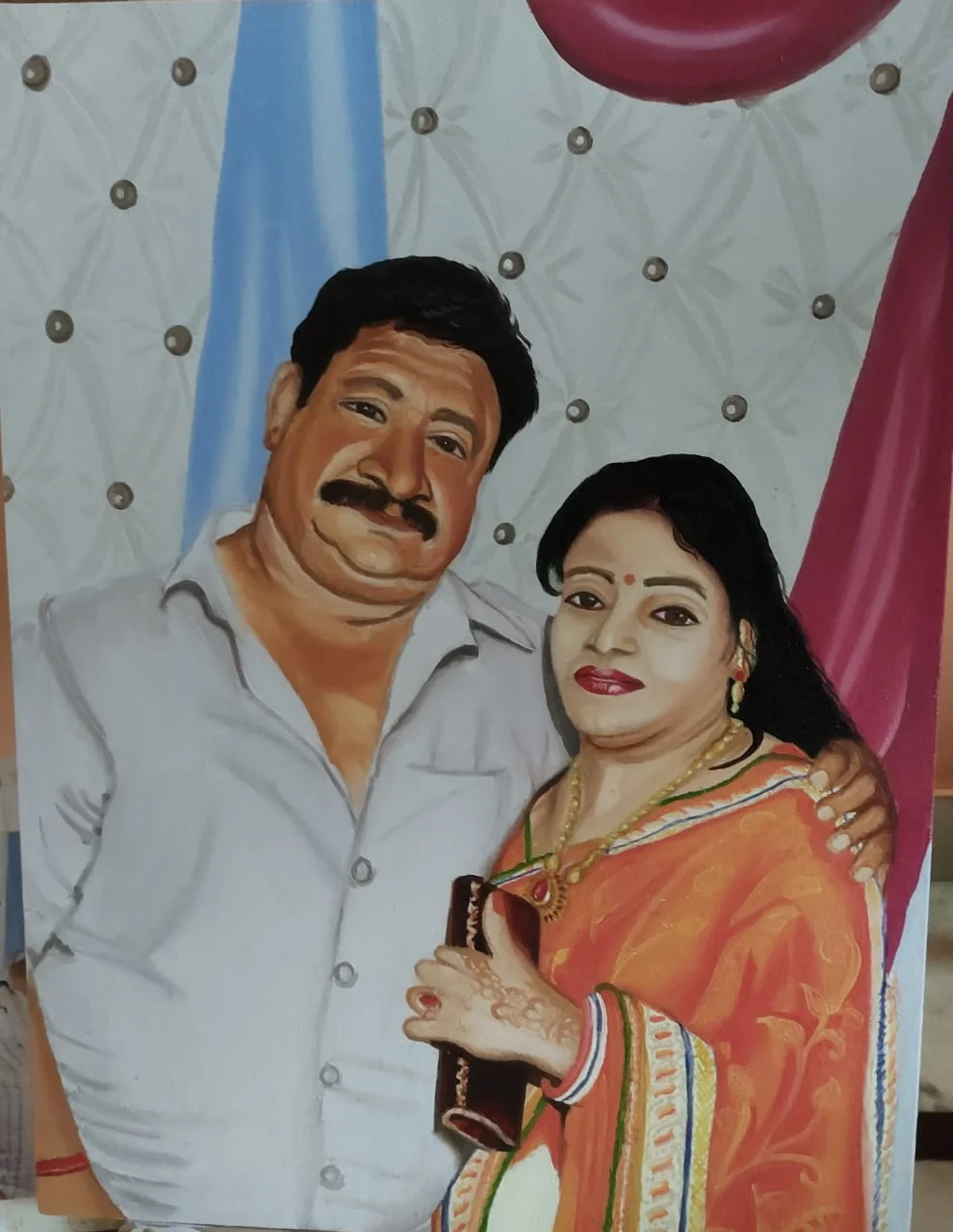
For enrolled students · what you'll actually do
28 exercises
28 exercises — tap any one to see what to do, what you learn, and what success looks like.
Oil is emotional. The first time you see light move across a wet layer of paint — the linseed scent rising, the brush dragging slow and reluctant — something clicks. You slow down. You realise painting isn't about finishing; it's about staying with one thing long enough, the paint cool and slick, to make it honest.
What this phase builds
Focus & the tools you'll meet
Focus areas
- 01
Fat-over-lean layering and working with slow-drying mediums
- 02
Colour temperature and edge control (hard / soft / lost)
- 03
From concept to finished canvas — blocking, refining, resolving
Tools you'll meet
- Oil paints (same primaries plus earth tones)
- Linseed oil / odourless solvent (or a solvent-free medium)
- Hog bristle and sable/synthetic brushes — stiff for laying, soft for finishing
- Primed stretched canvas — the real support for a finished work
- Palette, rag, and painting-medium cups — a clean, deliberate setup
At a glance · shareable
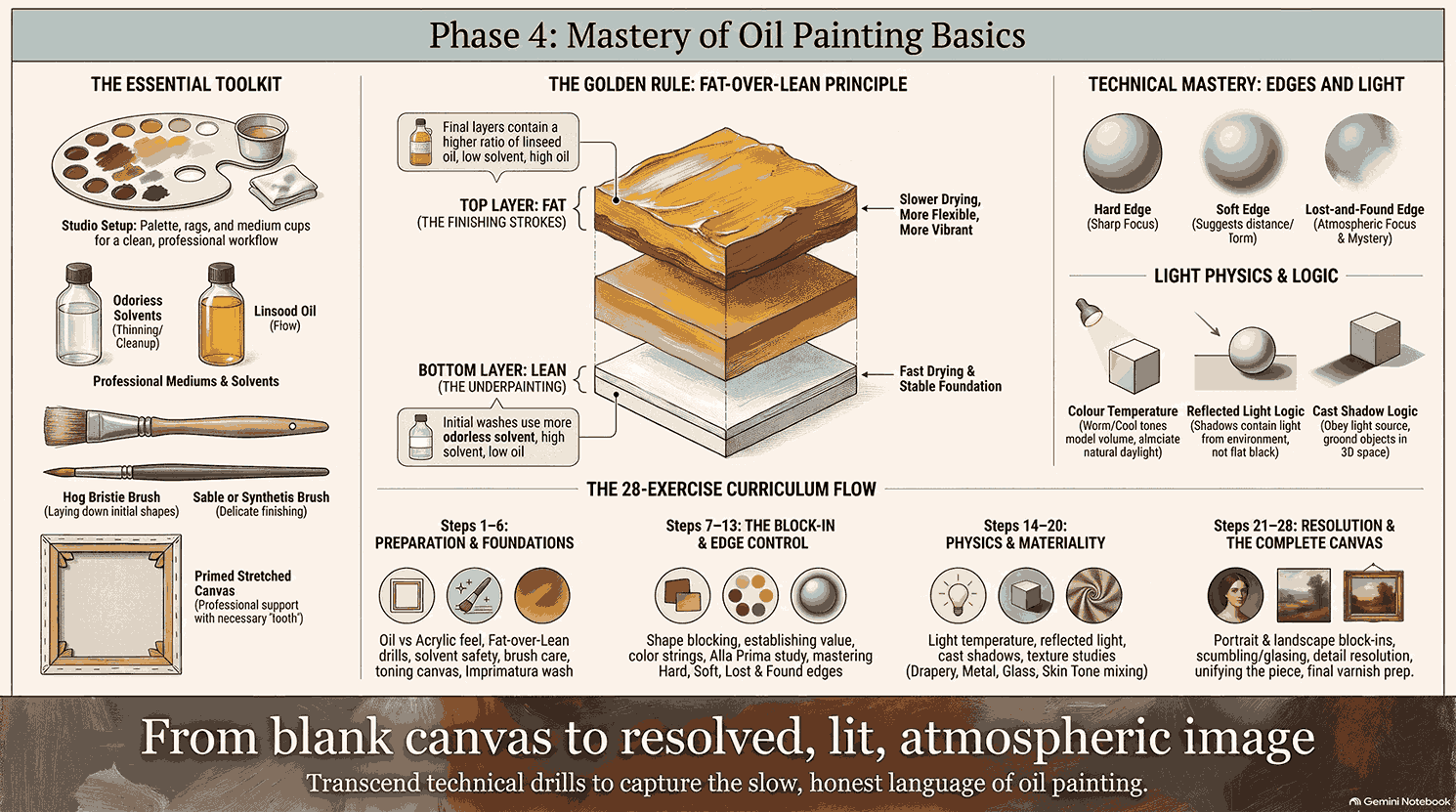
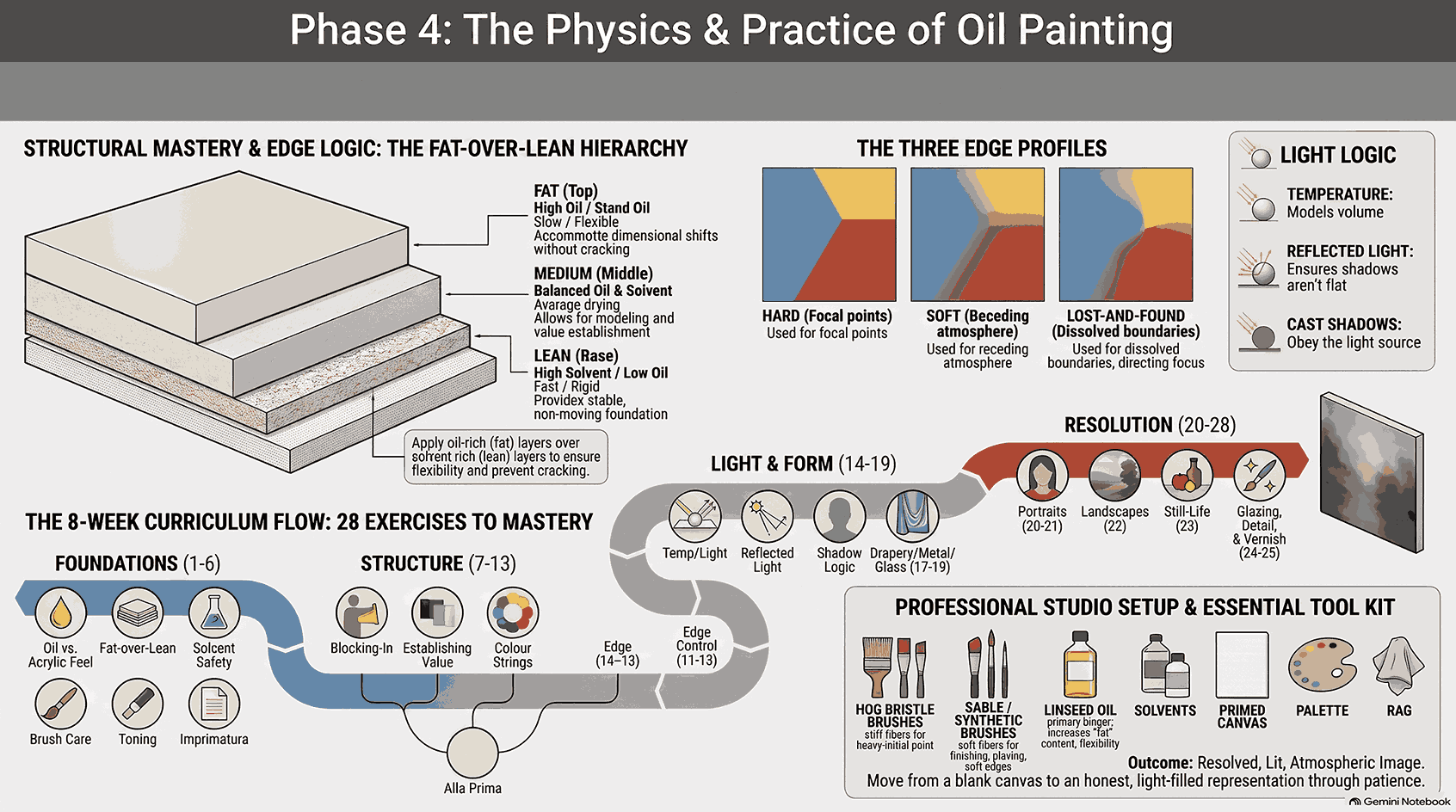
Phase infographic
A one-page visual cheat-sheet of the tools, focus, and practice in this phase.
For class · print
Slide deck
A printable exercise & tool deck — handy in the studio or to email home.
Open PDF ↗Download PDF ↓For you
Briefing doc for this phase
A plain-language overview of what this phase covers, who it's for, and how we judge readiness.
Dear Artist
One-line summary
Taking a painting from a blank canvas to a resolved, lit, atmospheric image using the slow, honest language of oil.
Who should step into oil
Stepping into the medium of oil is a significant milestone at Meenakshi Art Work academy, reserved for those who have demonstrated disciplined progression through the foundational stages of the curriculum. The academy adheres to a strict artistic ladder: Pencil → Acrylic → Canvas → Oil.
This progression is essential because oil painting requires a level of control and an understanding of colour that must be earned in previous phases. Skipping these preparatory steps invariably shows in the final work, leading to technical struggles that the slow-drying nature of oil will only exacerbate. Only students who have achieved mastery over form and value in Phase 1 and 2, and colour mixing in Phase 3, are ready to handle the complexities of the oil medium.
Key insights
- The Chemistry of Curing and Layering — Oil paint does not dry by evaporation like acrylics; it cures through a slow chemical process of polymerisation and oxidation. Following the "fat-over-lean" rule is vital for the painting's structural integrity: lower layers must be "lean" (thinned with solvent), while upper layers must be "fatter" (containing more oil) to remain flexible and prevent cracking, wrinkling, or delamination as the film contracts over time.
- Atmospheric Edge Control — An edge is created wherever one brushstroke or shape meets another. Mastery of this phase involves distinguishing between hard edges, which visually advance and attract attention to focal points, and soft or lost edges, which recede and dissolve boundaries into background values. Utilizing lost-and-found edges prevents the flat, cartoonish "cutout" look and creates a sense of atmospheric focus and mystery.
- Volume and Colour Temperature — Modeling 3D volume on a flat canvas is achieved by shifting colour temperature rather than just adding black or white. By utilizing warm lights and cool shadows (or vice versa), students create the sensation of natural daylight. Shadows must never be rendered as flat black; they must remain luminous and reflect the presence of secondary reflected ambient light from the surroundings.
- From Concept to Complete Canvas — The workflow in Phase 4 is systematic and deliberate. It begins with a warm wash (imprimatura) and a linear block-in of shapes, followed by establishing solid values. Forms are then refined using colour strings before finishing the piece with advanced techniques such as scumbling (light over dark for an airy effect) and glazing (dark over light for intensity), concluding with a protective varnish pass.
- Safe Studio Setup & Tool Care — Due to the chemistry of the medium, safety is paramount. Linseed oil-soaked rags must never be left crumpled in a pile because they can undergo exothermic spontaneous combustion; they must be air-dried flat or submerged in water. Proper ventilation is required even with odorless mineral spirits, as they still release volatile organic compounds. Brushes are cleaned with cool water and lipid-rich soap, then dried flat to prevent ferrule rot and shedding.
Voices
Oil is emotional. The first time you see light move across a wet layer of paint — the linseed scent rising, the brush dragging slow and reluctant — something clicks. You slow down. You realise painting isn't about finishing; it's about staying with one thing long enough to make it honest.
Phase 4 Student Reflection
Advancement happens purely when a student's work displays a resolved, lit, and atmospheric image built in the correct fat-over-lean sequence with intentional edges, never by the calendar.
Studio Note on Mastery
Readiness gate
The academy operates under a firm "no rushing" rule. Phase 4 consists of 8 weeks and 28 specific exercises, but these numbers are guidelines for the curriculum's depth rather than a guaranteed timeline for completion. A phase repeats until the techniques are mastered.
A student only moves forward when their portfolio displays a consistent ability to create a resolved, atmospheric image using correct chemical layering and edge control.
Practical next step
- Batch Times — Classes are held from 4:30 PM to 5:30 PM.
- Environment — We provide a dedicated women-only environment for girls aged 6+ and women of any age.
- Authenticity Rule — To ensure genuine skill development, every piece must be the student's own work. We maintain a strict policy of no tracing and no teacher finishing.
- Inquiries — Please direct all inquiries regarding specific batch windows and fees to the studio WhatsApp.
With warmth,
Meenakshi Art Work
Where you land
What you walk away with
You can take a painting from a blank canvas to a resolved, lit, atmospheric image using the slow, honest language of oil.
Curious about Phase 04?
Every phase is taught in person, one artwork at a time. Message us to ask about batches, timings, or where oil painting basics might fit in your journey.
Message on WhatsApp →Watch this phase on YouTube →